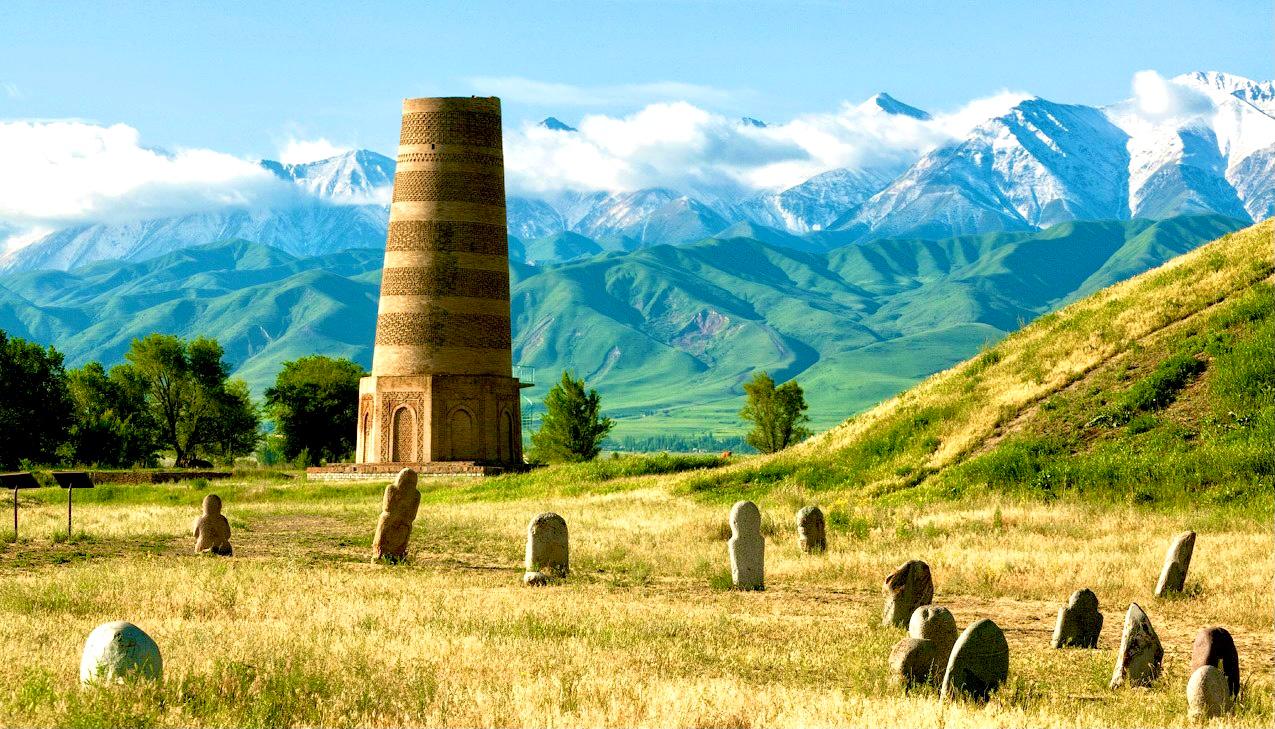
A solitary brick tower rises above the fields of the Chüy Valley, with mountains stretching across the horizon. Today the setting feels spacious and quiet, but these grounds once belonged to Balasagun, an important medieval city on the Silk Roads.
Burana Tower is its most recognisable surviving monument: a minaret whose patterned brickwork connects modern visitors with the Karakhanid period. Walk around its base, explore the archaeological grounds and study the carved stone figures nearby. If the staircase is open and suits your abilities, climb for a different perspective on the surrounding landscape.Located near Tokmok, approximately 80 km east of Bishkek, Burana works well as a history-focused excursion or a stop on a longer journey towards Issyk-Kul.
Burana Tower at a glance
| Planning question | What to know |
|---|---|
| Where is it? | Near Tokmok in the Chüy Valley, east of Bishkek |
| What was it? | A medieval minaret associated with the city of Balasagun |
| What can you see? | The tower, archaeological remains, stone figures and a small museum |
| How long should you allow? | Around 1–2 hours on site as a planning guide |
| Can you climb it? | When access is permitted; the internal staircase is steep and narrow |
| Is climbing essential? | No, the grounds and museum are worthwhile independently |
| What should you confirm? | Opening hours, current admission charges and tower access |
The suggested visit duration excludes driving. Allow longer if you enjoy archaeology, photography or a guided explanation.
Where is Burana Tower?
Burana stands in the countryside near Tokmok, within reach of Bishkek. It is a separate destination from Tokmok town itself.
When arranging transport, specify Burana Tower or the Burana archaeological complex, rather than simply asking for a ride to Tokmok.
Its location makes it a possible stop during a journey towards Issyk-Kul Lake. Include the detour and visiting time in your itinerary instead of assuming it is directly beside every eastbound route.
The history of Burana and Balasagun
A minaret from a medieval city
Burana is generally dated to the 11th century and associated with the Karakhanids, whose rule helped shape the region’s medieval urban and Islamic architectural heritage.
The tower was a minaret, not an isolated defensive watchtower. Its significance becomes clearer when you imagine the surrounding settlement rather than looking at it as a building standing alone.
Balasagun was an important Karakhanid centre. The archaeological remains preserve evidence of a much larger urban landscape than the standing tower initially suggests.
Why is the tower shorter today?
The surviving tower is commonly described as approximately 24–25 metres high. Historical reconstructions suggest that it was once substantially taller, often estimated at around 45 metres.
Earthquake damage and later restoration shaped the monument visible today. Those height figures should be understood as approximate, rather than precise measurements of every stage of its history.
Look closely at the brickwork instead of judging the site only by its size. The decorative bands give the structure texture and detail that are easy to miss in a quick photograph.
Burana and the Silk Roads
Balasagun belonged to a network of settlements connected by trade and cultural exchange. The Silk Roads were not one continuous road: they linked cities, agricultural areas, mountain crossings and communities across a vast region.
In 2014, the City of Balasagun, also identified as the Site of Burana, became a component of the UNESCO World Heritage property Silk Roads: the Routes Network of Chang’an–Tianshan Corridor.
The recognition concerns the archaeological site within a wider international property, not a separate listing for the tower alone.
Read about the UNESCO Silk Roads property.What to see at Burana Tower
1. The tower and its brick patterns
Begin with a slow walk around the exterior. From a distance, the tower is a simple silhouette; closer up, the bands of brick decoration become the main attraction.
Compare the patterns and the changing light on different sides. Give yourself time to appreciate the construction before joining any queue for the stairs.
2. The view from the top
When climbing is permitted, the upper platform offers a broad view across the surrounding plain. In clear weather, the mountain backdrop adds scale to the scene.
The climb is short in distance but can feel demanding because of the confined staircase. It is an optional part of the visit, not a requirement for enjoying Burana.
3. The carved stone figures
The stone figures displayed in the grounds are commonly called balbals in visitor descriptions. Their faces, hands and carved details deserve a closer look.
Many displayed stones were brought to the complex from elsewhere. Their present arrangement should not be mistaken for an untouched burial ground surrounding the minaret.
These figures and petroglyphs are different kinds of objects: a carved human figure is not the same as an image engraved on a rock surface. Use the labels and museum explanations to understand what you are looking at.
4. The small museum
The museum helps connect the standing tower with the city that once surrounded it. Archaeological finds provide context that an exterior photograph cannot.
Consider visiting the displays before exploring the grounds. Knowing what has been excavated makes the less obvious remains more meaningful.
Check whether museum access is included in your ticket and whether it is open during your visit.
5. The archaeological grounds
Beyond the tower, look for the remains and earthworks identified by site information. Much of an archaeological city is less visually obvious than a standing monument.
Follow permitted paths and do not climb walls or foundations for photographs. A guide can help explain the landscape without requiring you to enter protected areas.
Can you climb Burana Tower?
Visitors can climb when access is open, but the staircase is steep, narrow and dim. There is limited room to pass other people.
Before entering:
The climb may not suit people uncomfortable with enclosed spaces, steep stairs or heights. Children need close supervision.
If you have mobility requirements, ask specifically about the grounds, museum entrance and available facilities. The tower’s internal staircase is not a step-free attraction.
The legend of Burana Tower
A well-known story tells of a ruler who tried to protect his daughter from a foretold death by keeping her in a tower. Despite his precautions, the danger reached her.
Versions differ in their details, including the creature and the way it entered. It is a memorable piece of folklore, but it should not be confused with the tower’s architectural purpose as a minaret.
Hearing the legend alongside the history can enrich a visit, provided the two are kept distinct.
How to get to Burana Tower from Bishkek
Private car or driver
A driver is a straightforward option if you want to return to Bishkek or continue towards another destination.
Request a quote for the complete plan:
Ask for an estimated journey time based on your pickup point and the day’s conditions. The approximate distance from Bishkek does not translate into one fixed travel time.
Public transport via Tokmok
An independent approach can involve public transport to Tokmok followed by a local taxi to Burana.
Confirm the current departure location, service and fare before travelling. Older guides may quote routes or prices that no longer apply.
Arrange the return from Burana in advance. Reaching Tokmok is not the same as reaching the archaeological site, and waiting time should be part of your taxi agreement.
Guided visit
A guide can make the visit more rewarding if you want to understand Balasagun, the stone figures and the wider Silk Roads context.
Ask whether guiding is included throughout the excursion or only transport is provided. Confirm the language and the time available inside the complex.
Burana as a stop on the way to Issyk-Kul
Burana can add a historical chapter to a journey otherwise focused on lakes and mountains.
If you are travelling towards Bokonbayevo, Karakol or another Issyk-Kul destination, discuss the stop when arranging your transfer.
Keep the rest of the day realistic. Museum time, a possible staircase queue, lunch and the remaining drive all need space in the schedule.
A useful plan is to make Burana the main sightseeing stop of the transfer rather than adding several distant attractions.
Manas Airport transfers and visiting Burana
If you are arriving at Manas Airport, our airport transfer service can help you arrange the journey to your accommodation.
You can also enquire about a customised onward journey with a Burana stop. Provide your flight number, arrival time, passenger count, luggage and final destination.
Confirm that the museum’s visiting hours fit your arrival and allow time for airport procedures and rest. Admission, guiding and waiting at Burana should be agreed separately rather than assumed to be part of a standard airport transfer.
Opening hours and entrance fees
Check the complex’s current hours, admission price and tower access before departure.
A single reliable current tariff has not been confirmed for this guide. Rather than relying on an old figure, ask:
Arrive with enough time to explore before closing. If photography is your priority, remember that attractive evening light may fall outside visiting hours.
Best time to visit
Spring and autumn
Consider these seasons for a walking-focused visit, while checking the forecast for wind, rain and ground conditions.
The open setting means a light layer can be useful even when the temperature in Bishkek feels comfortable.
Summer
Plan for exposure to the sun. Bring drinking water, a hat and sun protection, and consider an earlier visit.
Do not rely on finding shade throughout the archaeological grounds.
Winter
A winter landscape can be atmospheric, but steps and paths may be slippery. Confirm opening and access before setting off.
Choose the exterior and museum if climbing conditions are unsuitable.
Photography tips
For a more varied set of photographs, try three perspectives:
Look for angles from permitted paths. Do not lean equipment against carved stones or use archaeological remains as a platform.
Ask before flying a drone; a broad open landscape does not automatically mean flight is permitted.
A suggested visit
Allow around 1–2 hours on site as a flexible starting point.
1. Confirm ticket inclusions and whether the tower is open.
2. Visit the museum for context.
3. Walk around the tower and study the brickwork.
4. Climb if conditions and your comfort allow.
5. Spend time with the stone figures and archaeological displays.
6. Return to your agreed pickup point.
The order can change depending on crowds or museum availability. Leaving time for the grounds makes the visit more complete than a climb alone.
What to bring
Carry snacks if Burana is part of a longer transfer, and ask your driver where a meal stop fits the route. Do not depend on a particular café or vendor being open at the site.
Frequently asked questions
Is Burana Tower worth visiting?
It is a rewarding choice for travellers interested in history, architecture and the Silk Roads. The museum and archaeological grounds give the tower its context.
How old is Burana Tower?
It is generally dated to the 11th century and associated with the Karakhanid period.
How tall is it?
The surviving structure is commonly described as approximately 24–25 metres high. It was originally substantially taller.
Is Burana a UNESCO World Heritage Site?
The City of Balasagun, or Site of Burana, is a component of the Silk Roads: Chang’an–Tianshan Corridor property, inscribed in 2014.
Do I have to climb the tower?
No. You can enjoy the architecture, museum and grounds without entering the staircase.
Is it suitable for children?
The grounds can suit a family visit with supervision. The confined staircase requires a separate decision based on the child’s ability and comfort.
How much time do I need?
Plan around 1–2 hours at the complex, plus transport. History enthusiasts may want longer.
Can I visit without a guide?
Yes, subject to the site’s current access arrangements. A guide adds explanation, especially for the archaeological remains and stone collection.
Can I combine it with a long Ala-Archa hike?
These are different excursions in different directions from Bishkek. If you want a full Ak-Sai Waterfall hike, separate days allow more time for both experiences.
Plan your Burana Tower visit
Tell us your date, pickup point, number of guests and whether you want to return to Bishkek or continue towards Issyk-Kul.
Contact GuideBook on WhatsApp to enquire about transport and a historical sightseeing itinerary. Confirm availability, included services, the total price and cancellation conditions before booking.