

An introduction to Kyrgyzstan
Kyrgyzstan is known for the Tian Shan mountains, high-mountain lakes such as Issyk-Kul and Song-Kul, and a cultural heritage shaped by livestock herding. The yurt is a portable home covered with a thick wool fabric. Horse-riding traditions, patterned carpets and the oral epic of Manas are other familiar parts of the country’s heritage. Understanding the country also means looking at its cities, food, languages and the people who carry these traditions into everyday life.
AI-generated illustration of a representative Kyrgyz mountain pasture; not a photograph of a named location.
Kyrgyzstan at a glance
| Question | Answer |
|---|---|
| Where is it? | Central Asia, between Kazakhstan, Uzbekistan, Tajikistan and China |
| What is its capital? | Bishkek |
| Does it have a coastline? | No; it is landlocked |
| What is its currency? | The Kyrgyz som, abbreviated KGS |
| Which languages have official roles? | Kyrgyz is the state language; Russian is an official language |
These basic facts help place the country on the map. Its official name is the Kyrgyz Republic; Kyrgyzstan is the familiar short form. National Investment Agency
Where is Kyrgyzstan, and how is it different from Kazakhstan?
Kyrgyzstan borders Kazakhstan to the north, Uzbekistan to the west, Tajikistan to the southwest and China to the east. Kyrgyzstan and Kazakhstan are separate countries, although their similar English names can be confusing. They have different capital cities, currencies and national institutions. Bishkek is the capital of Kyrgyzstan. National Investment Agency
There is no sea coast, but that does not mean water is absent from the landscape. Lakes, rivers and mountain streams connect high valleys with lower settlements. Looking at a map also explains why travel across a seemingly short distance can involve a long journey around a mountain range or over a pass.
Why mountains shape so much of the country
The Tian Shan extends across national borders, and its mountain ranges help define Kyrgyzstan's landscape. Mountain slopes, enclosed valleys and broad basins create very different environments within the country. The UNESCO-listed Western Tien-Shan, shared with Kazakhstan and Uzbekistan, is especially important for its forests, biodiversity and wild relatives of cultivated fruit crops. It is one part of a much larger mountain system. UNESCO
Elevation matters more than a photograph can show. A warm afternoon in Bishkek does not tell you what conditions will be like on a high pass. Higher ground is generally cooler, while snow, exposure and local weather influence when particular routes are usable. Mountain travel therefore follows the conditions of a specific valley or pass, rather than one nationwide summer timetable.
This variety also means that the country cannot be reduced to snowy peaks. Pastures, forested slopes, dry hills and cultivated valleys all belong to the same geographical picture.
Three lakes, three different landscapes
Issyk-Kul, Song-Kul and Ala-Kul are often mentioned together, but they represent quite different environments. Their names also appear in different transliterations: Issyk-Kul may be written Ysyk-Kol, Song-Kul as Son-Kol, and Ala-Kul as Ala-Kol. Recognizing these variants makes maps and local guides easier to follow.
| Lake | Landscape and setting | What helps explain its character | General access considerations |
|---|---|---|---|
| Issyk-Kul | A large lake surrounded by mountain ranges | Lakeside settlements, beaches and the surrounding biosphere reserve | Roads connect many shore communities; conditions and services vary by place and season |
| Song-Kul | A highland lake amid open grazing country | Summer pastures, herding and seasonal yurt accommodation | Mountain-road access and accommodation depend on seasonal conditions |
| Ala-Kul | A high-mountain lake in rugged terrain near Karakol | A setting associated with mountain trekking | Reaching it involves mountain walking; the route and conditions determine the difficulty |
Issyk-Kul is also an important ecological landscape. UNESCO describes a biosphere reserve with diverse habitats around the lake. Its depth, slight salinity and other local conditions help explain why the main body of water remains unfrozen through winter. That does not make the surrounding mountains or roads free of winter conditions. UNESCO
For geographical context, the site's guides to Issyk-Kul, Song-Kul and Ala-Kul describe these contrasting settings. A lake name alone is not enough to judge how accessible a place will be.
What jailoo means in everyday life
Jailoo means summer pasture. In a seasonal grazing system, livestock move between lower ground and higher pastures as weather and forage change. This movement connects the mountain landscape with the practical work of feeding animals and supporting rural households. The University of Central Asia's pasture research describes livestock movement from lower-elevation villages to remote mountain grazing areas. FAO / University of Central Asia
The word is useful because it names a working landscape. A summer pasture may be a place where visitors encounter yurts and horses, but it is also a place where people manage herds, prepare food and carry out daily tasks. Livelihoods come before the view.
Pasture management has contemporary challenges. FAO describes projects in which communities restore grazing land and forest landscapes. Seasonal livestock herding is therefore both a cultural inheritance and a current question of land use and rural livelihoods. FAO
Seasonal herding is one part of a society that also includes permanent villages, towns and cities. It does not describe how everyone in Kyrgyzstan lives.
How a yurt is built
A yurt combines a circular wooden frame with a wool felt covering. A folding lattice forms the walls; roof poles connect the walls to the roof crown, known in Kyrgyz as the tunduk. The structure can be taken apart and transported, making it suited to movement between seasonal homes. UNESCO recognizes yurt-making as a shared tradition involving Kyrgyz, Kazakh and Karakalpak communities. UNESCO
Building a yurt requires several crafts. Woodworking shapes the frame, while making wool fabric, weaving, braiding and sewing contribute to its covering and interior. Knowledge passes through families, communities and apprenticeships. The finished home reflects the work of the craftspeople who made it.
Yurts can serve different purposes, including seasonal accommodation and family gatherings. Their appearance and furnishings vary. Seeing a yurt in a tourist setting does not tell you everything about how another household uses one.
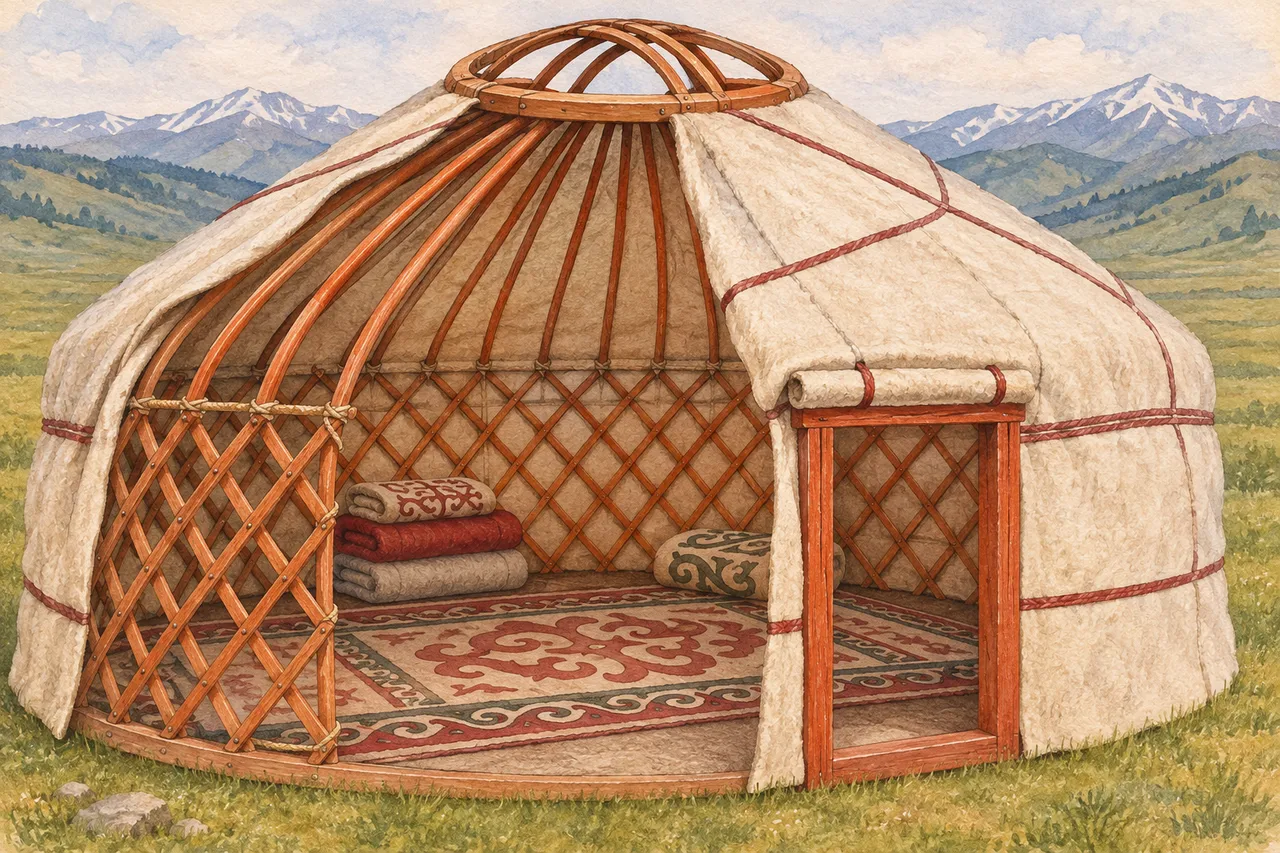
AI-generated interpretation of a felt yurt. This cutaway is illustrative, not a construction diagram.
What wool felt carpets reveal about craft
Felt is both a practical material and a medium for design. Two important Kyrgyz carpet traditions are shyrdak and ala-kiyiz. Both belong to a body of knowledge involving wool, pattern, color and the skills passed between makers. Their role includes warming and decorating living spaces. UNESCO
The techniques differ. A shyrdak uses pieces of colored wool felt that are cut and sewn together. In ala-kiyiz, the pattern is formed during the felting process. Preparing wool, arranging a design and finishing a carpet require skills learned through practice. Trip to Kyrgyzstan
Asking who made an object and how it was produced can reveal more than asking what a motif supposedly means. Patterns do not necessarily have one universal explanation, and contemporary makers also make individual choices.
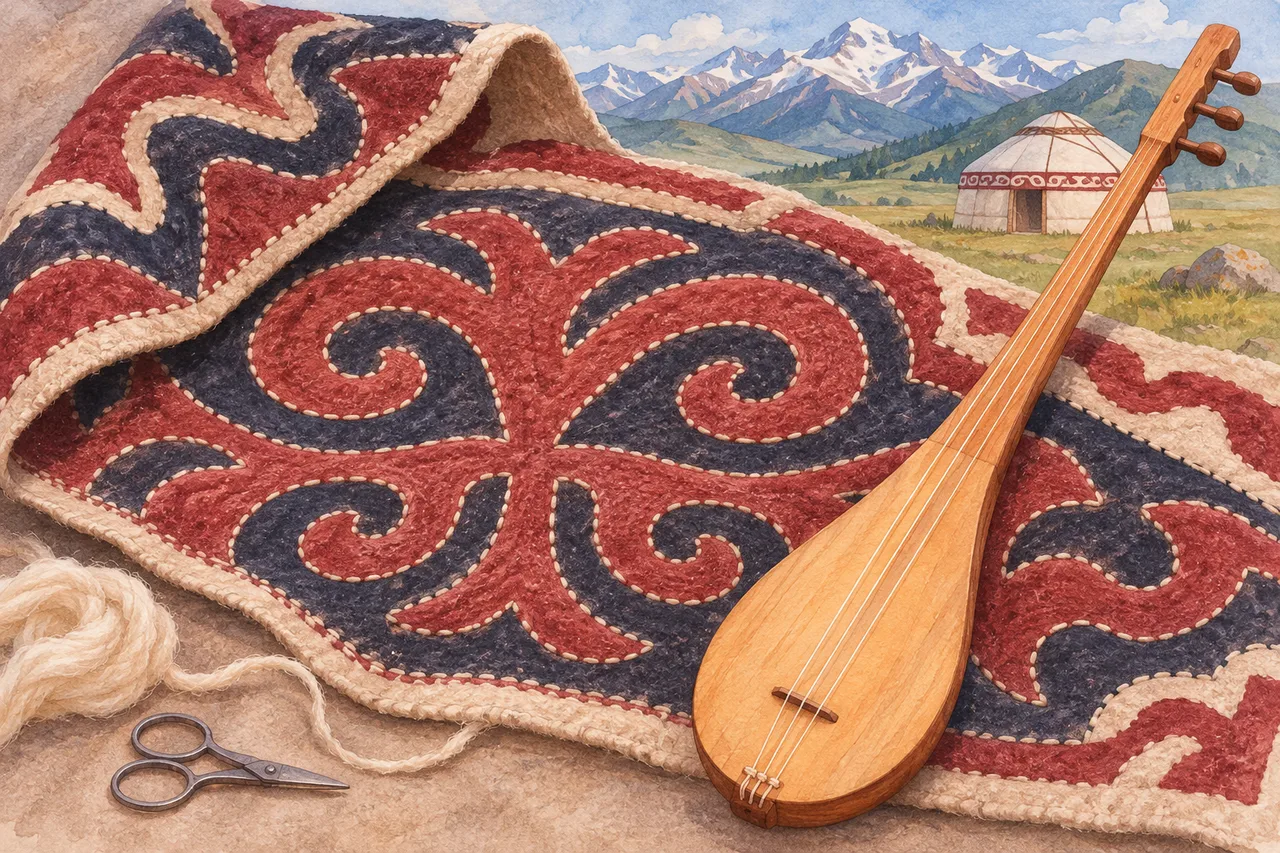
AI-generated illustration of felt craft and a komuz; not a photograph of an actual museum object.
The komuz and the sound of storytelling
The komuz is a three-stringed Kyrgyz lute. UNESCO's account of Kyrgyz epic tellers describes its use in accompanying some shorter epic traditions. Music and oral performance belong to the same broad cultural landscape, but they are not one uniform practice. UNESCO
That distinction helps when listening. Instrumental playing, sung poetry and spoken epic recitation draw attention to different skills. Knowing the name of an instrument is a starting point; noticing how a performer uses rhythm, voice or gesture gives a fuller understanding of the performance.
Why the epic of Manas matters
The Manas tradition centers on a cycle of stories associated with Manas, Semetey and Seytek. UNESCO recognizes the trilogy as an oral heritage through which historical memory, values and identity are communicated. Epic tellers carry the tradition through performance and transmission between generations. UNESCO
A Manas narrator is commonly called a manaschy. Recitation uses the voice, rhythm and gesture to convey the story; it should not automatically be described as a komuz-accompanied song. UNESCO distinguishes solo Manas narration from other epic performances that use instrumental accompaniment. UNESCO
The stories are epic literature, with legendary elements. Reading them as a straightforward chronology would miss their nature. Their importance lies partly in how people tell, remember and interpret them, rather than in treating every event as a documented historical fact.
Food, tea and hospitality
Food offers another way to understand the connection between household life and cultural tradition. Three names frequently encountered are beshbarmak, boorsok and kymyz. They refer to quite different foods and drinks.
Beshbarmak
Beshbarmak brings together boiled meat, noodles and broth, with preparations that vary. It is associated with shared meals and important gatherings. Neither the recipe nor the wider tradition belongs to a single household or stops at a national border. Advantour
Boorsok
Boorsok are small pieces of dough fried in oil. They can accompany tea or a larger meal, and may be served with dairy products or sweet additions. Their simplicity leaves room for differences in shape, texture and household recipe. Advantour
Kymyz
Kymyz, also written kumis or kumys, is a drink made from fermented mare's milk. Fermentation gives it its characteristic sourness and produces alcohol. It is a dairy drink, rather than a type of tea, and recipes and fermentation conditions vary. Advantour
Hospitality is easier to understand through an actual encounter than through a rigid list of national rules. Ask about an unfamiliar dish, explain dietary needs and follow the household's guidance. Describing a food as traditional does not mean that every person eats it, prepares it in the same way or serves it on every occasion.
Cities, languages and contemporary life
Bishkek and Osh belong in the picture alongside mountain pastures. The country's towns and cities are places of work, education, family life and cultural activity. Exploring Bishkek or Osh adds a different perspective from a lake or summer grazing area.
Language also deserves a precise explanation: Kyrgyz is the state language, while Russian has official status. These terms describe their formal roles; they do not mean that every person has the same language background or speaks both equally. National Investment Agency
Traditional skills can continue within modern lives. A person may live in a city, visit relatives in a village and value wool felt craft or epic storytelling without fitting a single picture of what a Kyrgyz life should look like.
Five questions that help explain the country
Is Kyrgyzstan part of Kazakhstan?
No. They are separate neighboring countries. Their names sound similar in English, but Kyrgyzstan's capital is Bishkek. National Investment Agency
Do people in Kyrgyzstan live in yurts all year?
Some households use yurts seasonally or for particular occasions. That does not describe the living arrangements of the whole country. Permanent villages and cities are central to contemporary life too.
Does Issyk-Kul's unfrozen water mean the region stays warm in winter?
No. The behavior of a large lake does not describe the weather on its shores or in surrounding mountains. An unfrozen lake and winter conditions can exist together. UNESCO
Is Manas a historical biography?
It is an epic tradition, not a modern biography or a verified account of every event. Its stories have cultural and literary significance alongside the historical memory they express. UNESCO
Can you understand Kyrgyzstan without going on a long trek?
Yes. Geography is part of the subject, but so are food, language, craft, music and urban life. Trekking offers one perspective; it is not a prerequisite for learning about the country.
A short glossary
| Local word | What it means |
|---|---|
| Jailoo | Summer pasture used for seasonal grazing |
| Yurt | A portable dwelling with a wooden frame and wool felt covering |
| Tunduk | The roof crown of a Kyrgyz yurt |
| Shyrdak and ala-kiyiz | Distinct traditions of Kyrgyz wool felt carpet-making |
| Komuz | A three-stringed Kyrgyz lute |
| Manaschy | A narrator of the Manas epic tradition |
| Kymyz | A drink made from fermented mare's milk |
Different spellings reflect different writing and transliteration systems. Keeping the local term alongside a clear explanation helps preserve its meaning when learning about Kyrgyzstan in another language.