
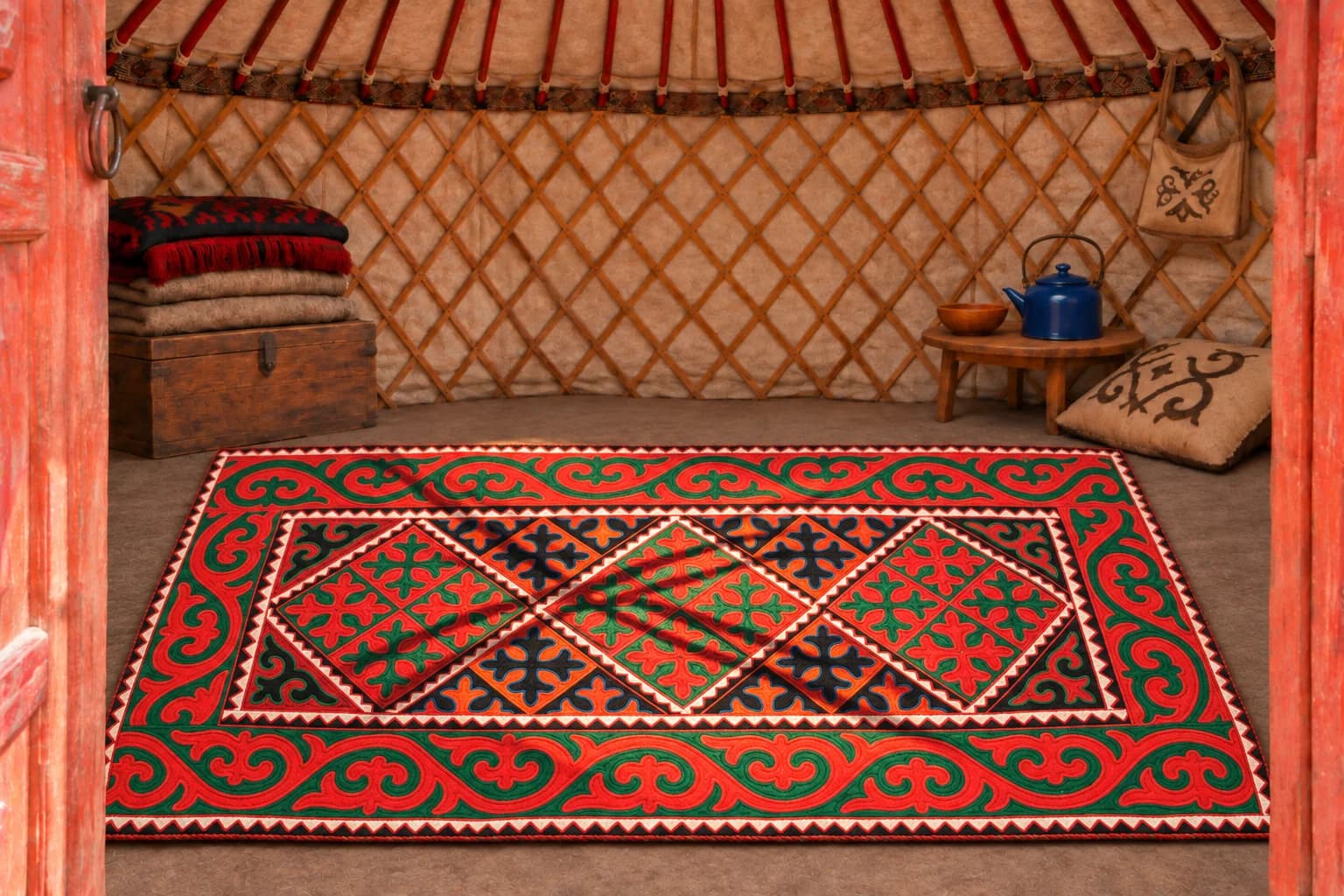
Pick a single curve on a Kyrgyz shyrdak and follow it with your eye. On one side of the curve, you might see a red shape curling into a cream background. Look across the rug and you may find its partner, a cream shape curling into red. Both began with the same cut. That small detail tells you how to recognize a shyrdak, one of Kyrgyzstan’s traditional felt rugs.
How one cut creates two patterns
To make a shyrdak, the artisan stacks two sheets of felt in contrasting colors and cuts a design through both at once. Imagine lifting a red curl out of the top sheet. A cream curl of exactly the same size lies underneath. Swap the pieces and each curl fits neatly into the opening in the other sheet. Even the narrow strip of felt around a tight bend has a place in the finished design.
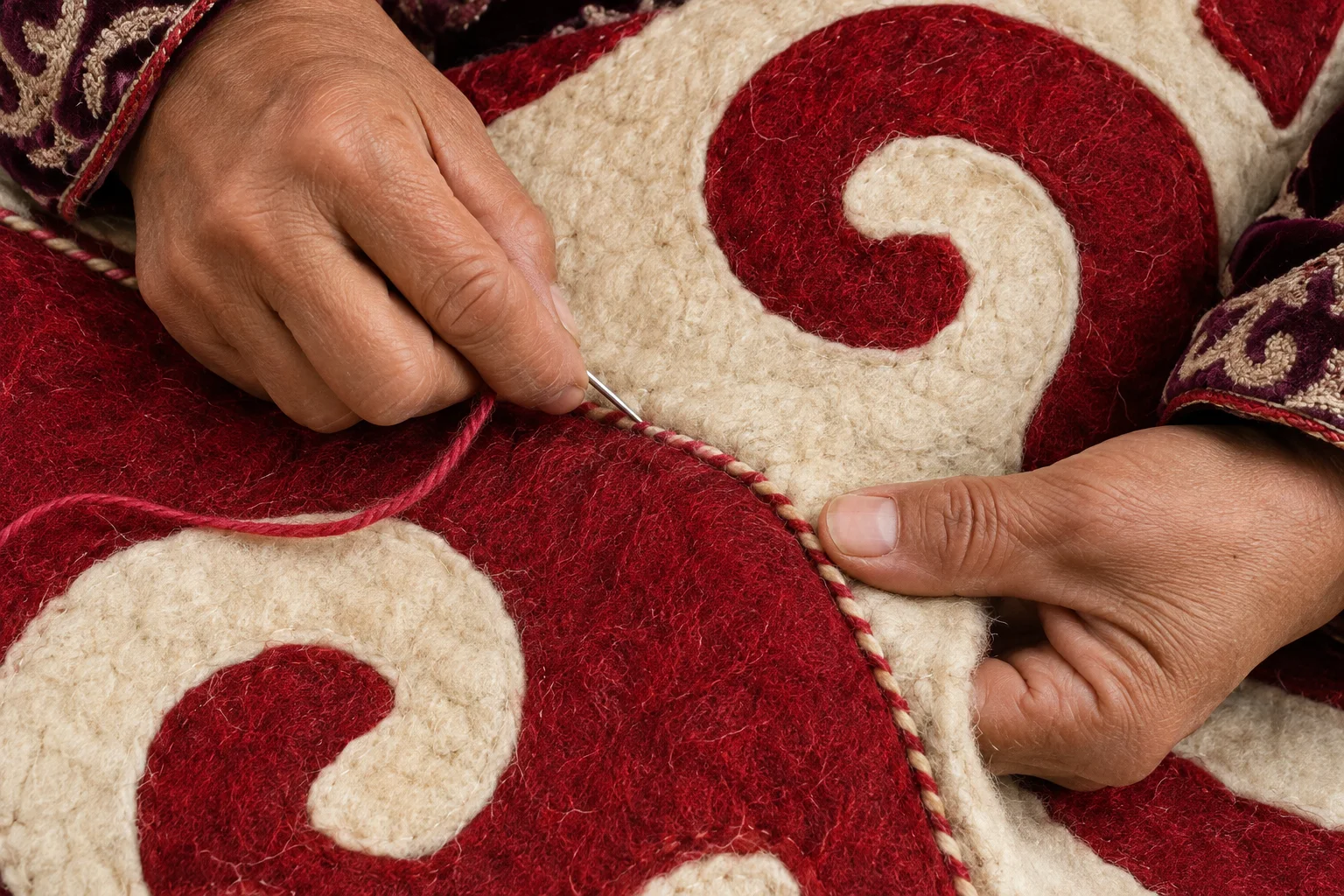
The artisan then sews the pieces together and attaches the patterned face to a thicker felt backing. From the far side of a room, the bold curves catch your eye. Up close, look for the line where the colors meet. What looks like a single sweep of color from a distance is an edge the maker had to cut, fit and stitch. International Quilt Museum
How to tell a shyrdak from an ala-kiyiz
Kyrgyz artisans also make a felt carpet called an ala-kiyiz. To tell the two apart, look closely at the edge of a motif. On a shyrdak, the adjoining pieces of felt form a distinct seam. For an ala-kiyiz, the maker lays colored wool into a design before felting it together with the base. The fibers bind as the carpet takes shape, giving the outline a softer edge. The difference is easiest to see where a narrow line of one color runs through another. World Crafts Council
What a finished rug can tell you
Felt carpets traditionally helped keep the interior of a Kyrgyz yurt warm, and making them brought people together. Experienced craftswomen passed on their skills to younger makers as they worked. There was practical knowledge in that exchange, from handling the wool to joining the pieces, alongside knowledge of ornaments and what they meant to the people who used them.
If you have the chance to speak with a maker, start with one detail you can both see. Point to a curve and ask what they call it, or ask them to show you the piece that was cut alongside it. If a rug is still in progress, look for the moment when the two colors change places. Once you have seen that exchange, you can follow the maker’s work across a finished shyrdak, one seam at a time. UNESCO